Research and Publications
Competencies and CBE

About
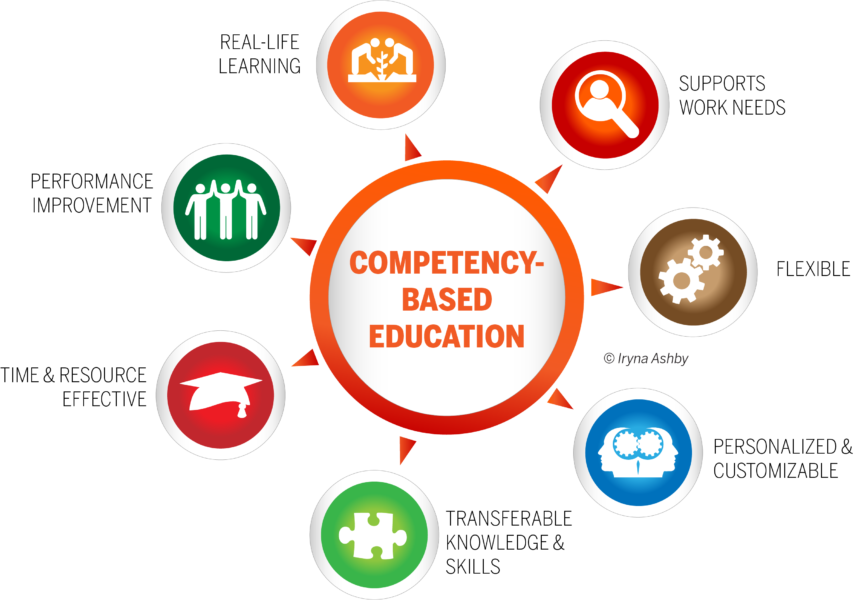
What is Competency-Based Education (CBE)?
Text description here
About
Projects
Knowledge, Skills, and Abilities for Instructional Designers and Educational Technologists
About this Research Project
We are exploring competencies needed on the job for professionals working as an instructional designer, educational technologist, technology integration coach/specialist, or related roles.
Mixed methods exploratory research
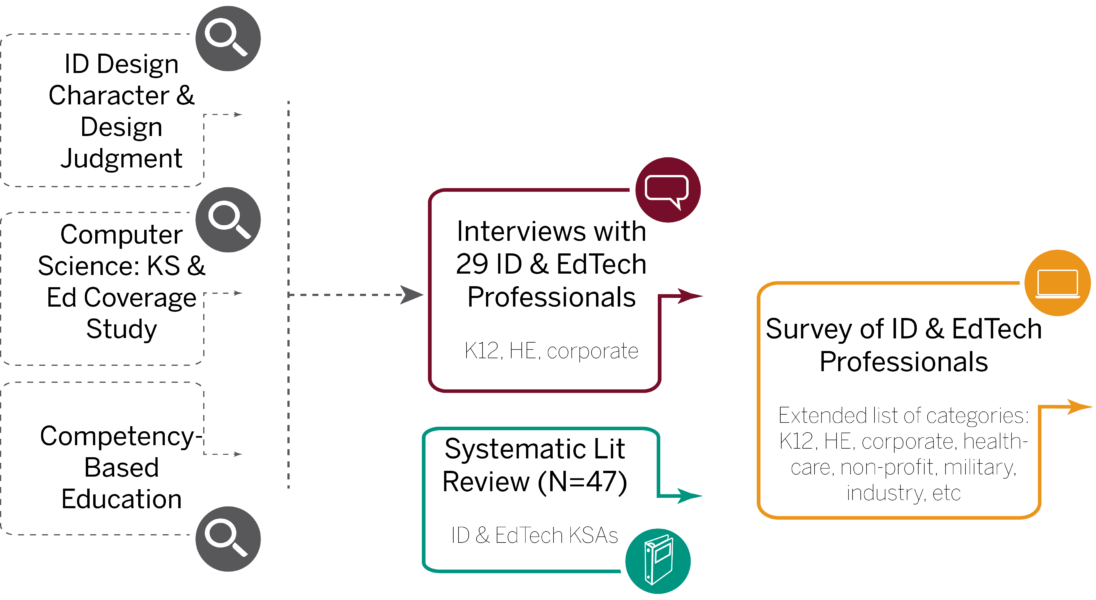
Research Threads
- Roles of instructional designers and educational technologists across settings
- Lifelong learning among instructional designers and educational technologies
- Competencies of instructional designers and educational technologists across settings
Key Presentations and Publications
Exter, M. & Ashby, I. (2020). Lifelong Learning by Design: Heutagogy and Learning Design and Technology Professionals. [Manuscript submitted for publication]
Exter, M., Ashby, I., & Cuesta, C. (2020). Knowledge, Skills, and Attitudes for Instructional Designers and Educational Technologists. Presented at the 2020 Virtual AECT Conference.
Huang, W., Ashby, I., & Exter, M. (2020). “What is an Instructional Designer?” View through the Lens of Technology Used. Presented at the 2020 Virtual AECT Conference.
Exter, M., & Ashby, I. (2019). Lifelong learning by design in learning design and technology. 2019 AERA, April 5-9, 2019, Toronto Canada
Ashby, I., & Exter, M. (2018). Keeping up-to-date: Lifelong learning practices of instructional designers and educational technologists. 2018 AECT International Conference (Kansas City, MS)
Exter, M., Krause, T., Randolph, A., & Ashby, I. (2016). What’s the Gap? Exploring Professionals’ Beliefs on KSAs Needed on-the-job & Coverage in ID Programs. 2016 International AECT Conference (Las Vegas, NV)
Computing Competencies
About this Research Project
As part of an ongoing series of studies, our team has explored competencies (skills, knowledge, and attitudes or dispositions) needed by computing professionals, and professionals’ views on computing education and life-long learning. This line of research has pointed to the importance of balancing foundational theory with applied skills and the ability to learn additional programing languages, technologies, techniques, and theory once on the job. Among the most important competencies are those relating to professional communication and teamwork skills, critical thinking, and lifelong learning skills and attitudes. Professionals’ ratings of importance of some traditional requirements, such as physical sciences and various types of mathematics, varied. One of the key recommendations for formal education is the use of projects of varying size and complexity, including both individual and team projects, full life-cycle projects, and the use of real-world practices such as change control and sophisticated debugging and testing utilizing tools similar to those used in industry.
This project strand is led by Dr. Marisa Exter.
Research Threads
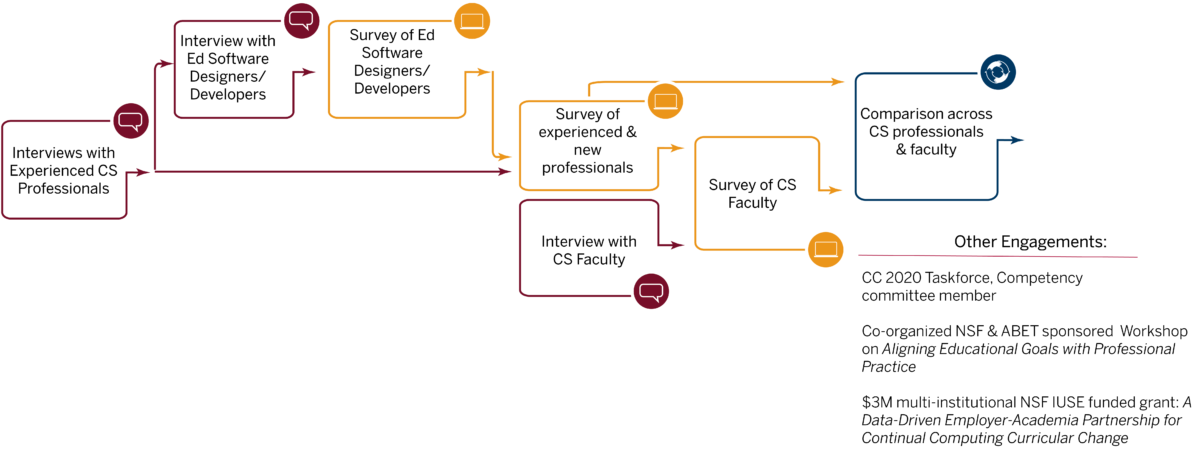
As shown in the figure, we have pursued this topic by utilizing several rounds of mixed-methods exploratory and explanatory research. Interviews with experienced computer science professionals (Exter & Turnage, 2012) and another set focused on educational software designers/developers (Exter, 2011) as well as interviews with computing faculty (Caskurlu, Exter & Ashby, 2016) provided an in-depth view of their experiences, while survey findings from professionals and faculty (Exter, 2014; Exter & Ashby, 2018; Exter, Caskurlu & Fernandez, 2018) provided a somewhat larger body of data.
In 2020, our Purdue team became part of a multi-institutional, multi-disciplinary initiative that aims to create a partnership between academia and industry with intent of providing data-based recommendations for moving towards a competency-based curricular model in computing education. Thus far, the team has hosted a Workshop on Aligning Educational Goals with Professional Practice (funded by the National Science Foundation and sponsored by the ABET accreditation organization) which brought together researchers, professionals, and educators. The National Science Foundation has funded a nearly $3,000,000 grant, “A data-driven employer-academia partnership for continual computing curricular change,” which will begin in 2021. The Purdue team will work together with partners from the University of Alabama, George Washington University, University of Illinois at Urbana-Champaign, University of New Hampshire, Rochester Institute of Technology, and Tuskegee University. This multi-pronged project will focus on research-based development of a competency-based curricular model for computing education, which will be piloted in three diverse institutions in Alabama through help of custom change management models, and disseminated at the national level.
Key Presentations and Publications
Exter, M., Caskurlu, S., & Fernandez, T. (2018). Comparing Computing Professionals’ Perceptions of Importance of Skills and Knowledge on the Job and Coverage in Undergraduate Experiences. Transactions on Computer Education, 18(4). 1-29. https://dl.acm.org/doi/10.1145/3218430
Exter, M., & Ashby, I. (2018). Preparing today’s educational software developers: voices from the field. Journal of Computing in Higher Education, 31(3), 472-494. https://doi.org/10.1007/s12528-018-9198-9
Caskurlu, S., Ashby, I., & Exter, M. (June, 2017). The Alignment Between Formal Education and Software Design Professionals’ Needs in Industry: Faculty Perception. Proceedings of the American Society for Engineering Education.. Columbus, OH. ASEE. https://peer.asee.org/28941.
Caskurlu S., Exter, M., & Ashby, I. (2016, April). Importance of lifelong learning skills and degree covered in undergraduate programs: faculty and practitioners’ perspective. Paper presented at the annual conference of the American Educational Research Association Annual Meeting, Washington, DC. View materials in ResearchGate.
Exter, M. E. (2014). Comparing educational experiences and on-the-job needs of educational software designers. Proceedings of the 45rd ACM technical symposium on Computer Science Education (SIGCSE). Atlanta, GA. https://doi.org/10.1145/2538862.2538970
Exter, M. E. & Turnage, N. M. (2012). Exploring experienced professionals’ reflections on computing education. Transactions on Computing Education, 12 (3). https://doi.org/10.1145/2275597.2275601
Exter, M. E. (2011). The educational experiences of software designers working in education/instructional technology related fields (Doctoral dissertation, Indiana University). View in ProQuest.
Case-Based Learning to Develop HPT Skills – Fast Food Case Study
Case: Situation, problem, or issue that is used as a pedagogical tool to show application of knowledge and skills.
Case studies can be:
- Fact-driven: a single solution
- Context-driven: multiple solutions
Benefits of Case-Based Learning
- “Active” learning
- Analytical, deductive thinking
- Critical thinking and problem solving
- Decision making in complex situations
- Coping with ambiguities
Traditional vs Partially Interactive Case Study
- Traditional Case: all information and supporting documents (if any) presented in the beginning
- Partially interactive Case: partial info is presented to learners, followed up by additional info based on learners’ questions

Suggested Readings
Ashby, I., Caskurlu, S., & Exter, M. (2018). Evolving roles of faculty at a new competency-based transdisciplinary program. Journal of Competency-Based Education, 3(1), e01059
Ashby, I., Exter, M., Matei, S., & Evans, J. (2016). Lifelong learning starts at school: Competency-based badge systems within the Transdisciplinary Experience at Purdue Polytechnic. In L. Muilenburg & Z. Berge (Eds). Digital badges in education: Trends, issues, and cases. New Work: Routledge
Cooper, T. (2017). People, processes, and philosophies: Designing a CBE program within a traditional university. In K. Rasmussen, P. Northrup, & R. Colson (Eds), Handbook of research on competency-based education in university settings (pp. 67-91), Hershey, PA: IGI Global
Ellis, D. (2015). What discourages students from engaging with innovative instructional methods: Creating a barrier framework. Innovative Higher Education, 40, 111-125
Klein-Collins, R. (2012). Competency-based degree programs in the U.S.: Postsecondary credentials for measurable student learning and performance. Council for Adult and Experiential Learning.
Koenen, A. K., Dochy, F., & Berghmans, I. (2015). A phenomenographic analysis of the implementation of competence-based education in higher education. Teaching and Teacher Education, 50, 1-12
Oyugi, J. (2015). Rationale and challenges of competency-based education and training: The “wickedness” of the problem. Journal of Education and Practice, 6(14), 74-79