Research and Publications
Interdisciplinarity in Education

Why Interdisciplinarity in Higher Ed?
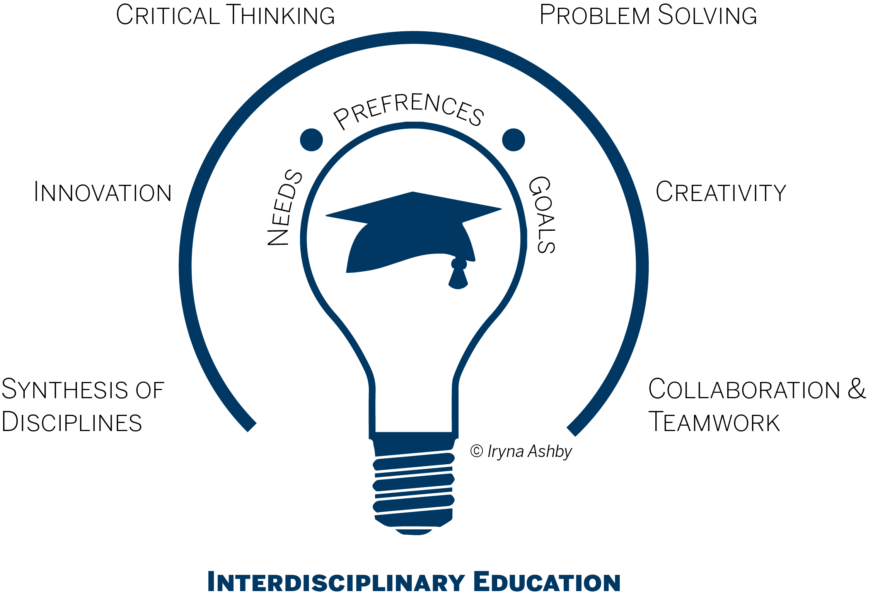
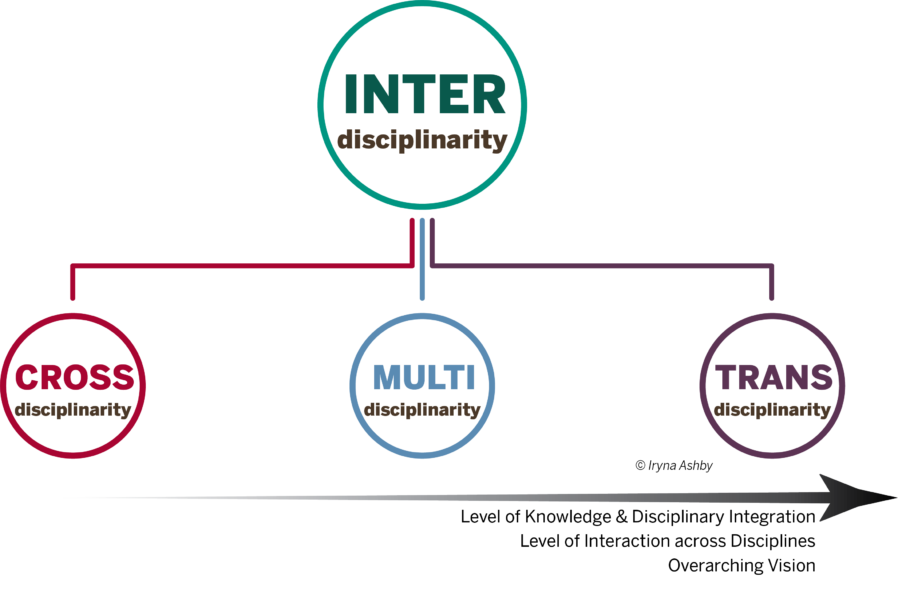
Interdisciplinary education can help students develop 21st century skills, and a wide range of cross-cutting professional skills. It enables students to look at the world through multiple lenses; synthesize disciplines to better understand phenomena; identify and connect interdependencies among disciplines or topics; and understand larger systems in which individual disciplines exist (Cotantino et al., 2010; Cowden & Santiago, 2016; Styron, 2013), where “knowledge […] is not applied in bits and pieces but in an integrated fashion” (Summers, 2005, p.627).
Projects
Interdisciplinarity in Higher Education: Administrator and Faculty Perspectives
About this Research Project
The study explores aspects and challenges of interdisciplinary program design, and how they align with considerations at each level of the university, including the institutional and college/department and program levels.
Methodology
Exploratory mixed-methods study
Exploring Interdisciplinary Learning and Collaboration
Developing high-quality educational software is a complex task, and typically requires a team of professionals with diverse expertise, including software engineering (SE), software development (SD), instructional design (ID), user experience design (UX), computer graphics (CG), and other specialists, based on goals and complexity of the design. While each discipline has its own preferred process model(s), in an interdisciplinary effort the processes followed by specialists must overlap, interact, or be incorporated into a larger project process. However, traditional academic programs tend to be siloed and rarely incorporate interaction with students or faculty from other programs, much less knowledge about processes, techniques, and language used in other disciplines. Learn more about the Educational Software Design course.
About this Research Project
A large part of this research is done in collaboration with students who enrolled in the course. We explore such topics as interdisciplinary learning collaboration, understanding topics from diverse disciplines, like process models, and more depending on the interests of the current student group.
Key Publications
Exter, M., Ashby, I., Yang, M., Farmer, T., McCord, B., & Sarwar, U. (2019). Developing process models for an interdisciplinary project-based class. 2019 Harvey Mudd Conference (California). https://drive.google.com/file/d/1ui_tfxnEccUH4lfpbOG9ZsucLTBn27ZJ/view?usp=sharing
Exter, M. (2018). Developing Multi-Disciplinary Skills through a Course in Educational Software Design. International Journal of Designs for Learning 9(1), 49-79.
Exter, M., Alshammari, A., Fernandez, T., Randolph, A., Chartier, K., Kuo, Y., Lancette, S., & Nemelka, B. (2018) Empowered Guinea Pigs: Stories of Cross-Disciplinary Projects in an Experimental Educational Software Design Course. In: Hokanson B., Clinton G., Kaminski K. (eds) Educational Technology and Narrative. Springer, Cham
Yang. M., Ashby, I., Sarwar, U., McCord, B., Farmer, T., & Exter, M. (under review). Educational Software Design in Practice: Understanding the Power of Intersecting Disciplines on Design Process through an Autoethnographic Approach. In Hokanson, B. (Ed.) Intersections across disciplines: Interdisciplinarity and learning design. New York: Springer-Verlag. [public release anticipated November 2020]
Evaluation of the Transdisciplinary Studies in Technology Program at Purdue Polytechnic
About this Research Project
The Transdisciplinary Studies in Technology Program is a state-of-the-art program that involves use of combinations of educational approaches, including competency-based education, transdisciplinary education, active learning, and project-based learning. The goal of the current project is to provide program evaluation and exploration of the effectiveness of educational innovations.
Methodology
Mixed-methods research
Key Publications
Ashby, I., Caskurlu, S., & Exter, M. (2018). Evolving roles of faculty at a new competency-based transdisciplinary program. Journal of Competency-Based Education, 3(1), e01059
Ashby, I., Exter, M., & Varner, D. (in press). Developing cross-cutting competencies for a transdisciplinary world: An extension of Bloom’s Taxonomy. In Hokanson, B., Clinton, G., Schmidt, M., Grincewicz, A. & Tawfik, A. (Eds.) (2019). A new Focus for Learning: Educational Technology Beyond Content. New York: Springer-Verlag. [public release anticipated November 2019]
de Cresce El Debs, L., Miller, K. D., Ashby, I., & Exter, M. (2018). Students’ perspectives on different teaching methods: Comparing newly developed and traditional courses in a technology program. Research in Science & Technological Education [electronic journal] https://doi.org/10.1080/02635143.2018.1551199
Exter, M., Ashby, I. & Cascurlu, S. (2019). Elusive expectations for a novel program design: Contrast between program intentions and student recruitment and retention. Journal of Competency-Based Education, e1192 https://doi.org/10.1002/cbe2.1192
Suggested Readings
Aldrich, J. H. (2014). Interdisciplinarity : its role in a discipline-based academy. New York, NY: Oxford University Press.
Ashby, I., & Exter, M. (2018). Designing for interdisciplinarity in higher education: Considerations for Instructional Designers. TechTrends. https://doi.org/10.1007/s11528-018-0352-z
Ashby, I., Caskurlu, S., & Exter, M. (2018). Evolving roles of faculty at an emerging hybrid competency-based transdisciplinary program. The Journal of Competency-Based Education, 3(1), e01059. https://doi.org/10.1002/cbe2.1059
Baker, W. D., & Däumer, E. (2015). Designing interdisciplinary instruction: exploring disciplinary and conceptual differences as a resource. Pedagogies, 10(1), 38–53. https://doi.org/10.1080/1554480X.2014.999776
Becher, T. (1994). The Significance of Disciplinary Differences. Studies in Higher Education, 19(2), 151–161. https://doi.org/10.1080/03075079412331382007
Becher, T., & Trowler, P. (2001). Academic tribes and territories : intellectual enquiry and the culture of disciplines (2nd ed.). Philadelphia, PA: Open University Press.
Holley, K. (2017). Interdisciplinary Curriculum and Learning in Higher Education. In Oxford Research Encyclopedia of Education. https://doi.org/10.1093/acrefore/9780190264093.013.138
Jacob, W. J. (2015). Interdisciplinary trends in higher education. Palgrave Communications, Vol. 1. https://doi.org/10.1057/palcomms.2015.1
Kandiko, C. B. (2012, July). Leadership and creativity in higher education: The role of interdisciplinarity. London Review of Education, 10, pp. 191–200. https://doi.org/10.1080/14748460.2012.691283
Klein, J. T. (2006). A Platform for a Shared Discourse of Interdisciplinary Education 1. Journal of Social Science Education © JSSE, 5(2), 10–18. Retrieved from www.jsse.org